Governance happens before propagation, not after.
Every piece of information ANKOR touches — a prompt, a tool result, a memory candidate, a message from another agent — passes through the same boundary before it’s allowed to matter: it arrives, it’s evaluated for admissibility, it’s routed by deterministic rule, and it either proceeds, waits, or stops. ANKOR calls this the Sort-Before-Store model: nothing is treated as fact, instruction, or context until it has cleared that boundary.
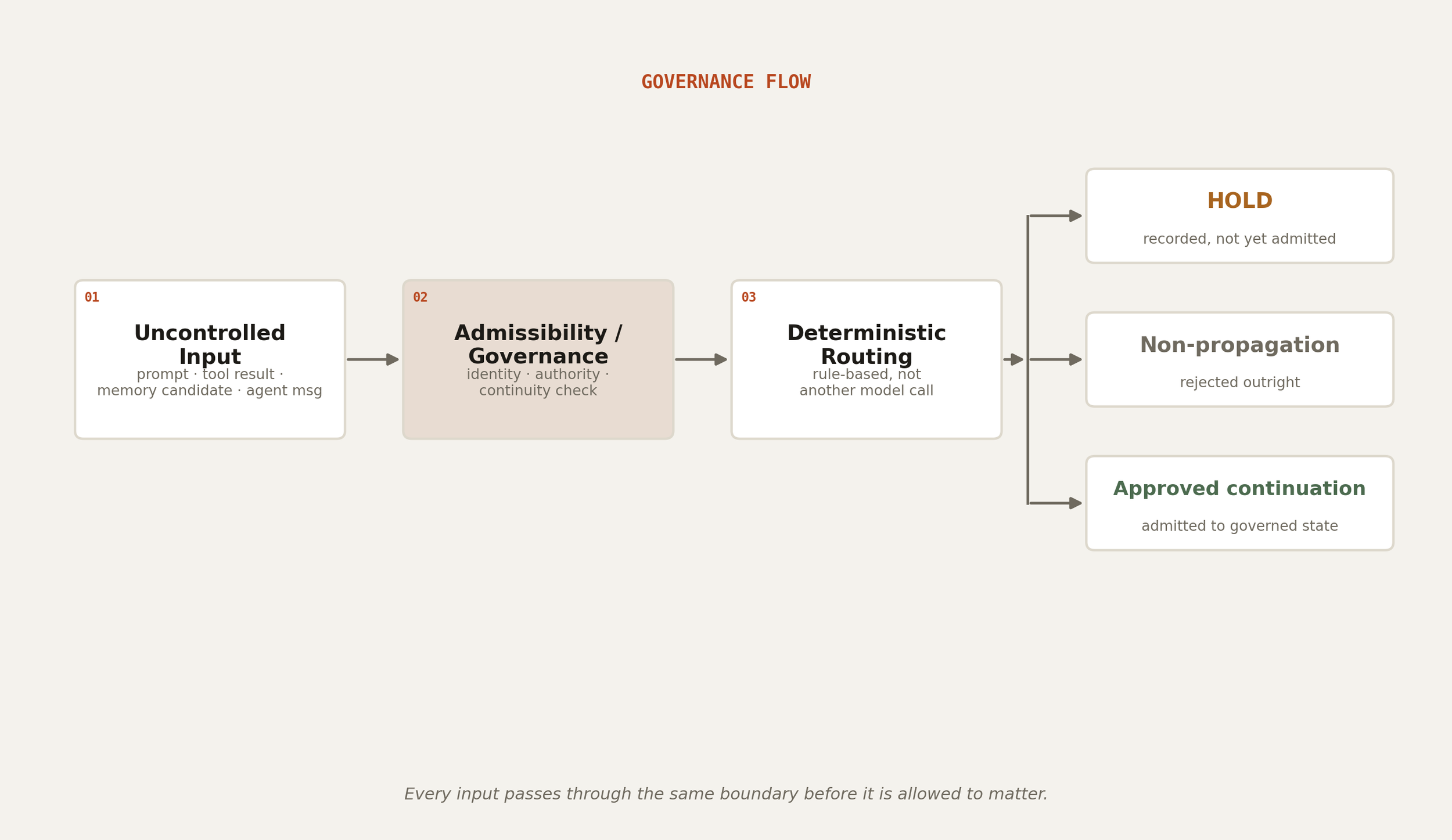
The Governance Flow
Incoming information is evaluated for admissibility before it’s treated as fact or instruction, then routed by deterministic rule — never another model call — to one of three outcomes: HOLD, rejected, or admitted into governed state.
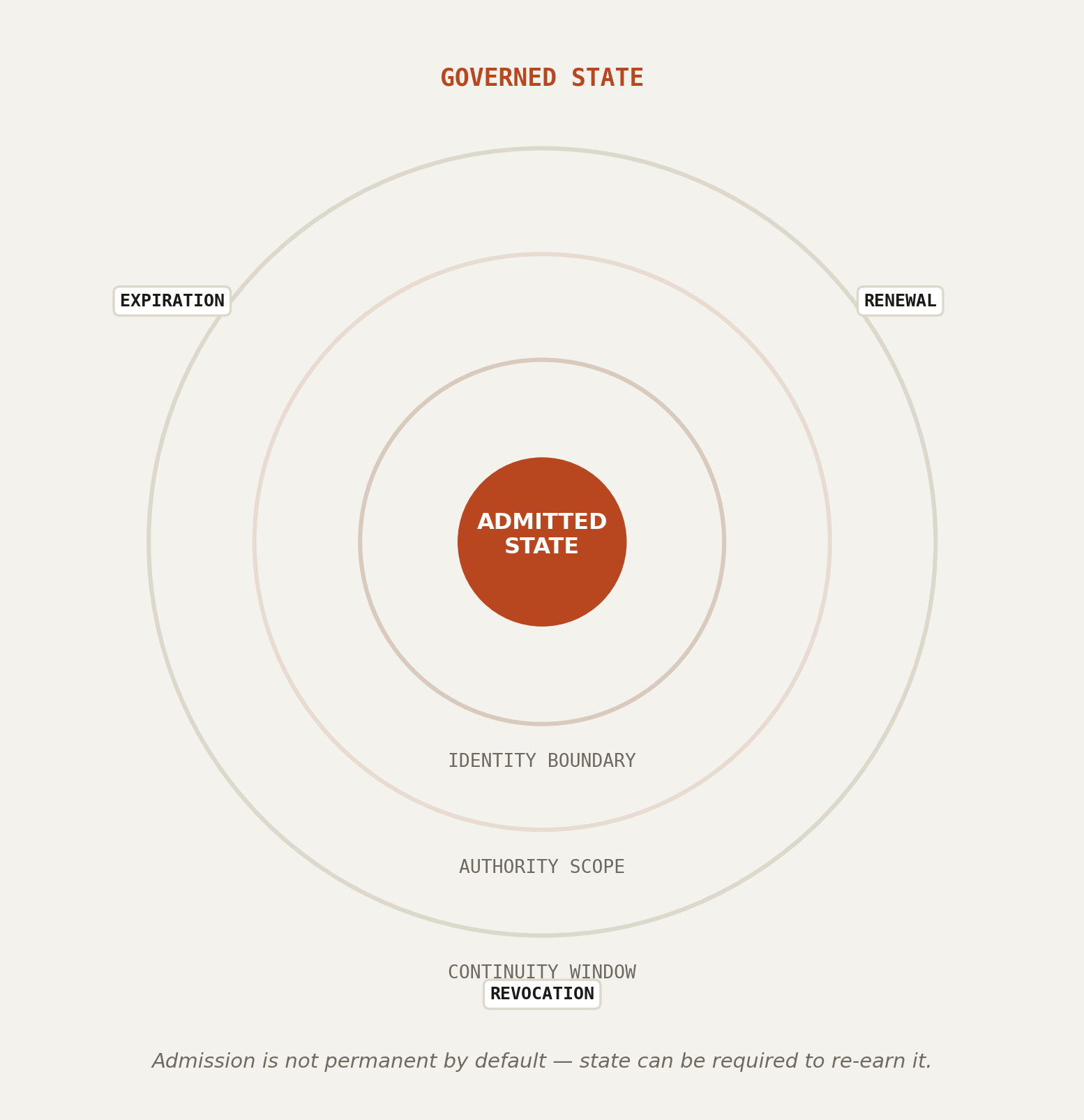
Governed State
Once admitted, information carries markers of where it came from, what admitted it, and under what boundary conditions it stays valid — which is what makes renewal, expiration, and revocation possible later.
BOUNDED EXECUTION · IDENTITY SEPARATION · MULTI-AGENT GOVERNANCE
Bounded Execution
Once state is admitted, ANKOR constrains what it is allowed to do. Execution is scoped to the authority the governed state actually carries, not the authority a system prompt claims or a plausible-sounding request implies. An agent cannot expand its own permissions mid-task; it operates inside a boundary fixed at admission.
Identity Separation
Who is acting is kept separate from what is being acted on. A tool result, a memory candidate, and a message from another agent each carry their own identity and provenance; none can borrow the authority of the system, the user, or another agent simply by arriving in the same context window.
Multi-Agent Governance
The same admissibility boundary applies when the input is another agent rather than a person. Messages between agents are evaluated for identity, authority, and continuity before they are treated as instruction, which is what keeps a multi-agent system from becoming a single ungoverned surface.
The Mural
Internally, ANKOR maintains a single reference diagram, the mural, that ties admissibility, routing, governed state, renewal, and multi-agent interaction into one map of the architecture. The diagrams on this page are excerpts of it. Every admission decision it describes, held, rejected, or approved, leaves an inspectable record.